
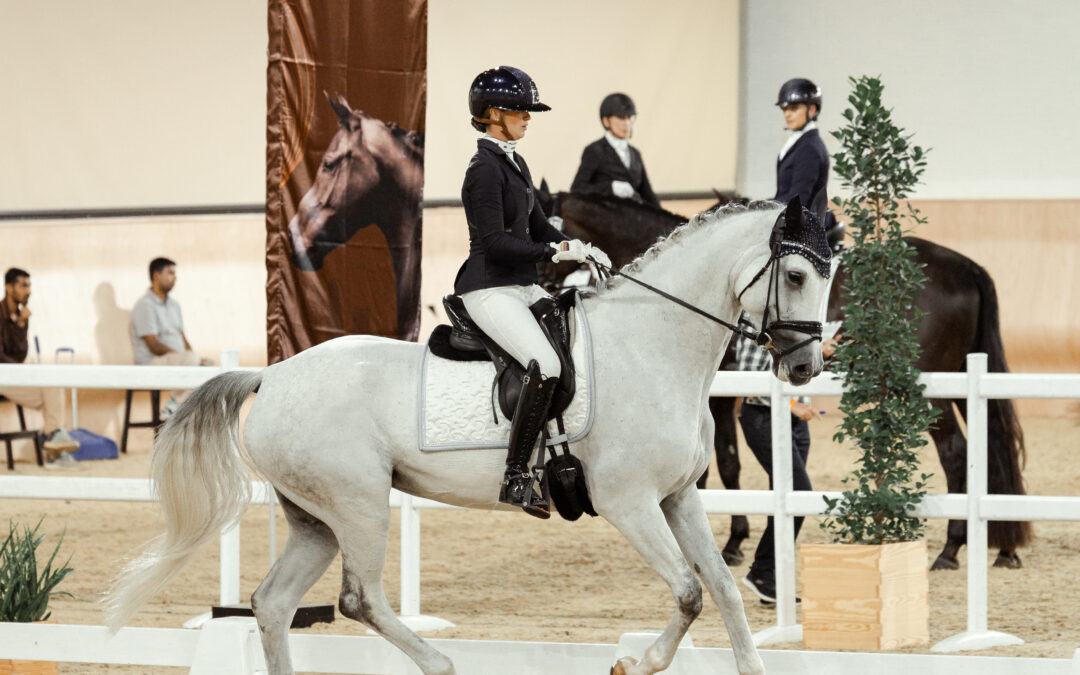
When the Iran conflict escalated across the region in early 2026, many people outside the Middle East assumed the equestrian world here had come to a standstill. The reality on the ground in the UAE has been more nuanced and, for those of us based here, considerably more normal than the international headlines might suggest.
I stayed in Dubai throughout March, continued to work with equestrian brands, riders and businesses across the region. What I have witnessed is an industry that, at the national level, has largely continued without interruption while international events took the expected hit and a community that adapted quickly and pragmatically to an uncertain situation.
Competition: National calendars held, international events cancelled
The clearest changes has been between national and international competition. Across the UAE, the national calendar has continued consitently.
In dressage, the UAE Dressage Championships took place in mid-April at the Royal Stables in Abu Dhabi as planned. Smaller national shows and training competitions have continued throughout April, May and into June at venues including Al Forsan and the Emirates Equestrian Centre. In showjumping, the UAE Championships, both Young Horse and Emirates Championship classes, ran in early May at Butheeb Equestrian Academy, and a summer national series is currently ongoing at Butheeb and Sharjah Equestrian Centre, both of which benefit from large indoor arenas that make competition doable despite the heat.
The polo season was largely already done when the situation escalated, but the 9th Edition of the Dubai Challenge Cup took place at Al Habtoor as scheduled in mid-March. Endurance, which remains one of the UAE’s strongest disciplines, saw a full calendar of CEI 1* through CEI 3* events in March and April, including the 120km Dubai Crown Prince Endurance Cup.
International events were, of course, a different story. Several shows scheduled for early in the year were cancelled, as was widely reported following the Global Champions Tour situation in Doha. One notable exception to the international calendar disruptions was the Dubai World Cup, which took place as planned with racehorses travelled into the region for one of the world’s most prestigious racing events, showing that international movement of horses into the UAE continued even during the most uncertain period.
However, it is worth to mention that we are now entering the UAE’s natural summer break, where the hot weather makes outdoor competition impractical regardless of the geopolitical situation. The 2026-27 international showjumping competition calendar has already been published, with international events scheduled to start from early October, including the President Cup and the Al Shiraa Tour – one of the region’s flagship events – in January 2027.
On the international stage, the UAE teams have not missed anything. The UAE dressage team is currently competing in Europe and started at CDI Lier last week, preparing for the Asian Games 2026. The UAE showjumping team is also on European tour and had a notably strong performance at Al Shiraa Lissabon.
Mood: Cautious at first, now largely normal
The mood within the equestrian community here has evolved since March. In the early weeks, there was understandable uncertainty, of course nobody knew how far the situation might escalate, and responses varied widely. Many riders and owners flew out temporarily. Cargo and transport was disrupted, which had obvious implications for horse movement.
However, the majority of riders who left without their horses first have since returned. Those who were already planning to relocate horses to Europe for the summer competition season – a routine annual migration for many UAE-based competitive riders – simply moved their timelines forward by a few weeks, leaving in late March or early April rather than early May, once cargo flights normalised.
The broader community has settled into something that feels, from the inside, very close to normal. The stables are active, training continues, and the conversation has largely shifted from ‘what is happening?’ to ‘what is next?’ and ‘excited for things kicking off again in September’.
Business: Largely unaffected, with some sector exceptions
One of the most important points and one that is often missed in international coverage is that residential and commercial areas across the GCC were largely unaffected. Stables, training facilities, and equestrian businesses were not disrupted in any physical sense.
From a business perspective, the picture has been one of continuity. My own clients have continued operating throughout. One example: I work with an equine air freight company that was naturally affected when flight operations were disrupted in the initial period. As soon as cargo flights resumed, they were immediately back to moving horses – flying UAE-based horses out to Europe and the UK for the summer season. Most of those clients have already booked return flights for August and September.
Equipment and product imports have remained strong. Demand for saddles, tack, and equestrian equipment has continued, with brands including for example Kingsley actively growing their presence in the market. The equestrian consumer in the UAE has proven, once again, to be resilient and consistent.
The sector that has felt the impact most is tourism and hospitality, fewer international visitors means less visitors at venues that depend on tourist activity. But for businesses serving the equestrian community, it has been business as usual.
Looking ahead: Confidence in the region’s future
The question I am asked most often by European brands and industry contacts is: should we still be investing in the Middle East? My answer, and the answer of most people I speak to within the regional equestrian community, is a yes.
The UAE has a consistent track record of bouncing back strongly from disruption and there won’t be anything to allow the current situation to derail another season. Infrastructure investment in equestrian facilities across the Emirates continues. The direction from the government and private sector to grow the sport here has not diminished.
Beyond the UAE, the region’s broader equestrian ambitions remain very much intact. The FEI Endurance World Championship is scheduled for November in AlUla, Saudi Arabia and preparations are underway. AlUla has invested significantly in becoming a world-class equestrian destination, and that has not changed.
From where I sit in Dubai, the picture for autumn 2026 onwards is one of cautious optimism which, as it happens, is exactly the score that 27 equestrian CEOs gave the industry globally in our recent CEO Report: 7.2 out of 10. In the Middle East, I would give it at least that.
About the Author
Caroline Bucher is the founder of The Canter Club, a strategic digital marketing agency focused on the global equestrian industry, based in Dubai. She is also a competitive dressage rider. In 2026, The Canter Club published the Global Equestrian Industry CEO Report 2026 – the first consolidated CEO-level insight study dedicated to the equestrian sector, based on interviews with 27 senior leaders across 8 countries. The full report is available at www.thecanter.club.